I know my audience is super into brain health, so today, I’ve got some things to share that will expand your mind and offer new perspectives on treating brain disorders.
Today, high level:
- This controversial metal could be a key component of Alzheimer’s development
- Could heat therapy treat depression? (Short answer, yes!)
- A conversation that might make you question our reality
- Are you taking GLP-1 meds? You might need to be aware of THIS
Let’s jump in!

Let’s talk about water.
Plastic bottles? Packed with microplastics and nanoplastics. Tap water? Not much better. Studies show it can contain everything from chemical pollutants to traces of prescription drugs (yes, even birth control residue).
That’s why I’ve been such a big advocate for filtering your water—and why I’ve been using the same system for years: AquaTru.
AquaTru is a countertop reverse osmosis purifier with a 4-stage filtration system that removes up to 15x more contaminants than the leading filters. It’s built with BPA- and BPS-free plastics, it’s easy to use, and honestly—the water tastes incredible.
AquaTru is offering my community $100 off an AquaTru Reverse Osmosis filter when you CLICK THIS LINK.
Protect your health. Protect your family. And enjoy water the way it’s supposed to taste: pure and clean.
Study: Could Lithium Help with Alzheimer’s Disease?
All right, we’re starting off strong with a study that everyone is talking about.
Lithium has long been used in the treatment of psychiatric disorders (such as bipolar), and even though it comes with some stigma, it’s still one of the most powerful treatments for brain-related disorders…and it might even help in the prevention and treatment of Alzheimer’s.
In a new animal study from Harvard, researchers used a lithium compound in mice and found that it reversed Alzheimer’s-like brain damage, cleared plaques and tau tangles, and even restored memory (all without toxicity and at doses 1,000 times lower than lithium meds).
Basically, our brains naturally contain small amounts of lithium, but these levels shrink as Alzheimer’s develops. That’s because toxic amyloid plaques actually trap lithium, robbing the brain of its neuroprotective benefits.

Image via Harvard.edu
Even though this is an animal study, there are other examples of the protective benefits of lithium in humans. One population study from Denmark found an inverse correlation between lithium in drinking water and incidences of dementia.
This research could be a complete game-changer for Alzheimer’s treatment, which is desperately needed since it’s one of the fastest-growing diseases in the world.
I know the question that you’re asking, which is the same question that I’m asking, “Great! What can we do right now to take action on this information?”
From what I’ve gathered, the top experts in this space are very cautious about making any recommendations about taking lithium orate through supplementation because the research is early.
But they all say that it’s worth making sure to audit your diet and that you are eating foods regularly that contain lithium.
I asked ChatGPT for a breakdown of the top foods that have naturally occurring lithium orotate in them, and here’s what it showed.
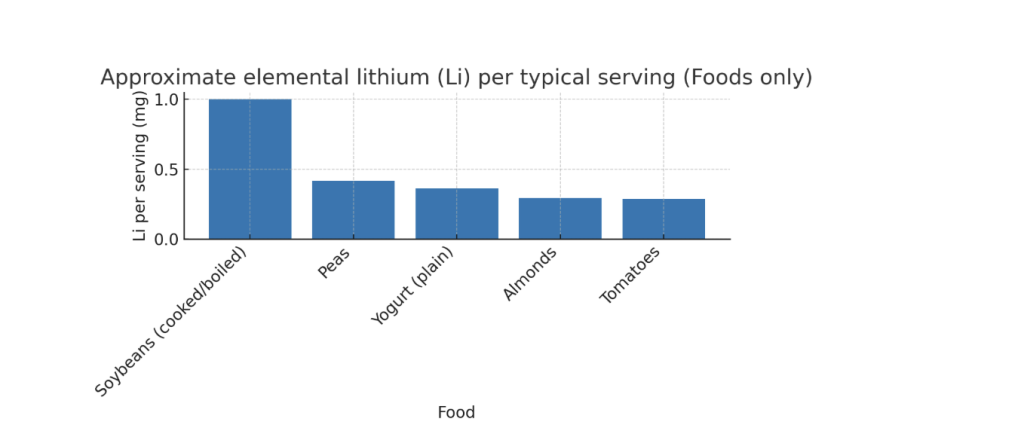
If you want to read more about this study and the powerful impact of lithium, physician and scientist Dr. Eric Topol has a great breakdown on his Substack that I highly recommend.
Study: Hyperthermia as Treatment for Depression
If you or anyone you know is struggling with depression, this one is pretty fascinating. In a small, randomized, double‑blind trial, 34 people with depression (no meds) were randomized to a single session of whole‑body hyperthermia (heating the participants to 101.3°F using a hot‑infrared bath) or a pretend “sham” version.
The results? Across six weeks, people who got the real heat treatment showed significantly lower depression scores (measured by the Hamilton scale) than the pretend group. The drop was noticeable as early as week one and lasted through week six. Importantly, there were no serious side effects.
A few weeks ago, I posted about the powerful benefits of a hot bath (which are comparable to saunas), and it’s pretty cool to see what things like heat therapy and cold therapy can do for people, especially since they are affordable and accessible for the most part.
Shoutout to Brandon Luu, MD, on X for highlighting this study.
Tweet: Are You Taking a GLP-1 Agonist? Pay Attention to This.
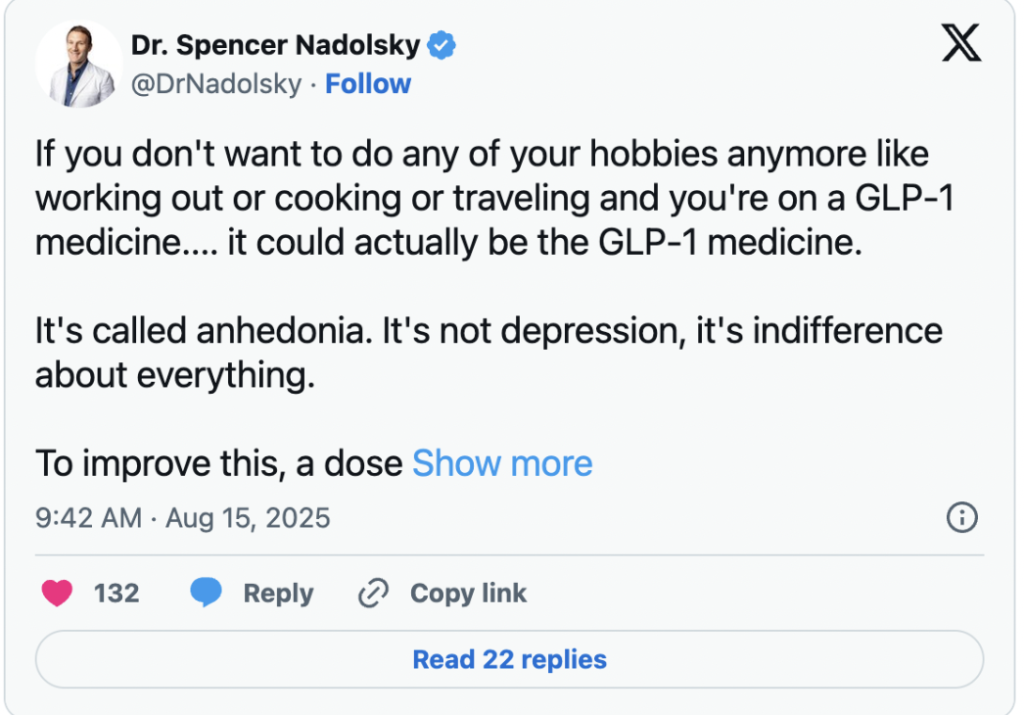
I have some family friends who are currently taking GLP-1 and have experienced some changes in personality, including feeling grumpy, anxious, and even depressed. Look, this is all anecdotal, and I cannot say for sure the medication is causing these challenges, but after seeing this tweet from Dr. Spencer Nadolsky, I’m a little more convinced that these folks could be experiencing GLP-1drug-induced anhedonia.
I’m looking more into the mechanism behind this, but some have said that it could be dopamine related—these drugs might be “over-dampening” our pleasure centers. I’m not sure if this is accurate, but I will report back if I learn more.
If this sounds like you and you’re taking one of these medications, it could be worth talking to your doctor to see if you need to modify your dose or introduce other therapies or lifestyle changes.
Podcast: Big Theory of Everything
Have you ever listened to something that makes you question everything (in the best way possible)?
In this podcast episode, physicist Tom Campbell dives into why consciousness, not matter, is the fundamental building block of our reality. Think of our universe as a virtual reality, our bodies are avatars in an information-driven system, and every experience, choice, and emotion is played out on this grand simulated stage.
I know it sounds kind of trippy, but stay with me.
Campbell pulls from decades in physics and consciousness research (from NASA to the Monroe Institute) to show how things like free will, love, and intention shape not just our personal journeys, but the evolution of consciousness itself. The more we let go of fear and ego, the more we lower the “entropy” (chaos) in this system, and the more we grow spiritually.
For anyone out there who has strong religious beliefs, he doesn’t say faith is wrong. Instead, he reframes it through the lens of science. Whether you call this bigger intelligence God, the larger consciousness system, or something else entirely, the takeaway is an invitation—an invitation to make decisions from a place of love and service instead of fear and watch how your life changes.
If you’ve been feeling stuck or feel like you’re hitting roadblock after roadblock, this episode is especially for you.
That’s it for this week!!
Much love,
Dhru Purohit