Today, I want to highlight a new study that caught my attention (and frankly, what felt like the whole internet) because it made a pretty astounding suggestion: just 3-4 minutes of vigorous exercise a day can lower cancer risk.
Most of us know that movement matters for cancer prevention. But here are the questions this study actually asks:
- How little movement is enough to make a real difference?
- Does it have to be structured exercise, or can everyday bursts of intensity count?
A large study just published in JAMA Oncology has some answers worth sitting with and also begs a few questions…


Let’s talk about water. Plastic bottles? Packed with microplastics and nanoplastics. Tap water? Not much better. Studies show it can contain everything from chemical pollutants to traces of prescription drugs (yes, even birth control residue).
That’s why I’ve been such a big advocate for filtering your water—and why I’ve been using the same system for years: AquaTru.
AquaTru is a countertop reverse osmosis purifier with a 4-stage filtration system that removes up to 15x more contaminants than the leading filters. It’s built with BPA- and BPS-free plastics, it’s easy to use, and honestly—the water tastes incredible.
AquaTru is offering my community $100 off an AquaTru Reverse Osmosis filter when you CLICK THIS LINK.
Protect your health. Protect your family. And enjoy water the way it’s supposed to taste: pure and clean.
Researchers from the UK Biobank, one of the most rigorous health datasets in the world, tracked over 22,000 adults who reported doing no leisure-time exercise at all.
Instead of measuring gym sessions, they used wrist-worn accelerometers to capture something called VILPA: Vigorous Intermittent Lifestyle Physical Activity.
Think of it as the accidental intensity that sneaks into a normal day. Sprinting to catch a train. Carrying groceries up a flight of stairs. Walking to your next appointment at a pace that actually gets your heart going.
Not exercise. Just life, moved through with some urgency.
Participants were followed for nearly seven years. Researchers tracked who developed cancer overall, and specifically a group of 13 cancer types already known to be sensitive to physical activity levels, including breast, colon, and endometrial cancers.
What did they find?
Compared to people who got zero VILPA, those who accumulated just 3.4 minutes per day saw a 17 to 18% reduction in total cancer risk.
For physical activity-sensitive cancers specifically, the effect was even sharper.
The study’s median daily VILPA of 4.5 minutes was associated with a 31 to 32% reduction in risk for those specific cancer types.
The dose-response was nearly linear, meaning more was generally better. But the steepest gains came at the lowest end of the curve.
And nearly all of this, 92% to be exact, was accumulated in bouts of intense movement for one minute or less.
Ok, that seems exciting, but let’s break down what this does and doesn’t mean.
What This Study Did and Didn’t Show
First of all, this was an observational study, not a clinical trial. It shows association, not causation. The researchers can’t say with certainty that the VILPA caused the lower cancer rates.
While the study was carefully adjusted for age, sex, diet, sleep, smoking, alcohol, and family history of cancer, here are a few questions we need to ask ourselves:
1) Could it be that generally healthier people are more capable of vigorous activity? Yes, probably.
2) Does this mean that we should only focus on short amounts of vigorous activity and forget about doing longer, structured, or slower workouts? No.
We know that any movement done consistently is going to lower our disease risk, especially cancer. And there’s a chance that if you’re able to perform shorter bouts of vigorous movement throughout the day, you are probably in physically better shape than someone who is sedentary or cannot move “vigorously.”
The reason I do find this research a bit exciting is that if you’re short on time and physically capable, know that short bursts of exercise are actually meaningful.
Many people over 40 are not getting regular structured exercise. Not because they don’t care, but because life is full, and it’s easy to assume that if you can’t do it right, there’s no point doing it at all.
This study is a direct challenge to that thinking. Something is definitely better than nothing.
And there are some really simple ways to accumulate your daily VILPA:
- Take the stairs at a challenging pace, not a stroll
- Walk to your next meeting or errand fast enough to actually feel it
- Carry your groceries instead of rolling them (bonus points for doing some grocery bag curls)
- Take the long way, at full speed
- Do a quick bout of push-ups or squats between calls or meetings
But don’t let this excuse you from more structured workouts. In fact, if you want to be able to perform VILPA into your 50’s, 60’s, 70’s, and beyond, those more structured workouts probably hold the key.
The more movement, the better!
And remember, when it comes to avoiding cancer, exercise is one of the surest bets for lowering your risk. Remember this post from our friend Satchin Panda?
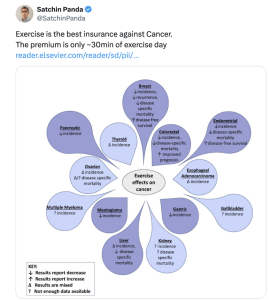
Here’s to more Vigorous Intermittent Lifestyle Physical Activity : )
Dhru