Try This family, today I have three great shares for you.
High level:
- A dinner tip that could protect your heart
- If you’re a hothead, have anxiety, or are stressed, work on this!
- Health-obsessed folks, you’ll love this post
Your kitchen is one of the most used spaces in your home. It’s where mornings begin. Where dinners bring everyone together. Where conversations happen.
So why settle for cookware that looks purely functional… and may not even be safe?
One of the reasons I love Our Place is that their cookware doesn’t force you to choose between performance, safety, and design.
The Titanium Always Pan Pro is sleek, beautifully designed, and built without PFAS. It feels premium in your hand and performs just as good as it looks.

Why it stands out:
✨ Titanium interior that’s 300 percent harder than stainless steel
🔥 Safe up to 1000°F
⚡ Fully clad, tri-ply construction for fast, even heating
🧼 Dishwasher safe and easy to clean
🏡 Replaces multiple bulky pans to simplify your space
I use mine daily. Crispy salmon. Sautéed greens. Pan-fried sweet potatoes. Simple egg scrambles. It heats beautifully, cleans easily, and actually makes cooking feel more enjoyable.
Our Place stands behind it with a 100-day risk-free trial, free shipping and returns, and a limited lifetime warranty. For a limited time, get 10% off sitewide when you shop through my link. Because the best kitchens aren’t just functional. They’re intentional.
Number 1: Want to Protect Your Heart? Eat at Least 3 Hours Before Bed.
Here’s a pretty simple way to support your blood pressure and your blood sugar.
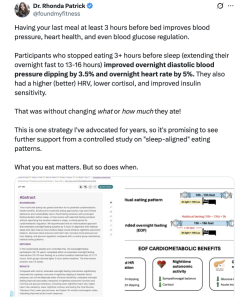
Shout-out to @foundmyfitness on X for this share
In a trial published this month, middle-aged and older adults were encouraged to finish eating at least three hours before bedtime and to match their fasting window with the time they naturally sleep. The research showed that this circadian-aligned fasting approach (without reducing calories) led to improvements in key heart health indicators overnight and during the day.
Participants had better nighttime blood pressure dipping, meaning their hearts got deeper rest while sleeping. Other benefits included lower nighttime heart rate, improved heart rate variability (a marker of autonomic balance), lower nighttime cortisol, and better glucose regulation, suggesting that coordinating eating with your body clock helps your cardiometabolic systems recover more effectively each night.
These findings point to a simple but powerful truth: timing matters. Eating earlier and allowing your body to complete digestion well before sleep gives your cardiovascular system a better opportunity to reset and repair during rest.
Number 2: Want to Be Happy and Less Angry? Work On Your Cardio.
If you or anyone you know has a short fuse, is angry, or gets stressed out, send them this.
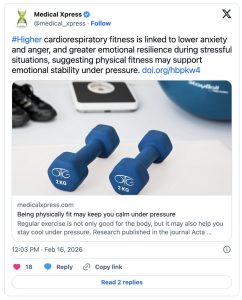
Regular aerobic fitness doesn’t just strengthen your heart; it also helps you stay cooler under emotional pressure.
A brand-new study found that people with higher cardiorespiratory fitness (think: better endurance from activities like brisk walking, running, cycling, or consistent aerobic workouts) showed much lower anxiety and anger responses when exposed to stressful or upsetting stimuli compared to less fit individuals.
Researchers had 40 healthy young adults view unpleasant images designed to trigger stress and measured changes in their anxiety and anger responses. Those with higher predicted VO₂max (a key measure of fitness) not only started with lower baseline anxiety and anger but also showed smaller spikes in these emotions after exposure to stressful scenes.
In contrast, participants with below-average fitness were much more likely (up to 775 percent!) to shift from moderate to high anxiety in response to stress.
This suggests that better aerobic fitness doesn’t just improve your body; it may help buffer your emotional reactions to real-world stressors.
Importantly, cardiorespiratory fitness was also linked with lower trait anxiety overall, meaning fitter individuals tend to feel less anxious in general, not just in stressful moments.
As with most healthy habits, they don’t just serve one part of your body; they benefit the entire system!
Number 3: Being a Health Enthusiast Makes You Resilient.
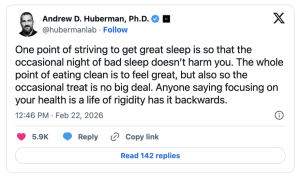
I loved this post from Andrew Huberman. I used to get “made fun of” for being really into health and being careful about what I eat and my daily inputs. But in fact, when you take good care of yourself, you’re able to really sink into moments of joy and pleasure without completely falling off the wagon or feeling like crap for days. This is the goal: to be resilient!
See you next week.
Much love,
Dhru Purohit
The information in this newsletter is for educational purposes only and should not be construed as medical advice; please consult a qualified healthcare professional before making any health-related decisions.